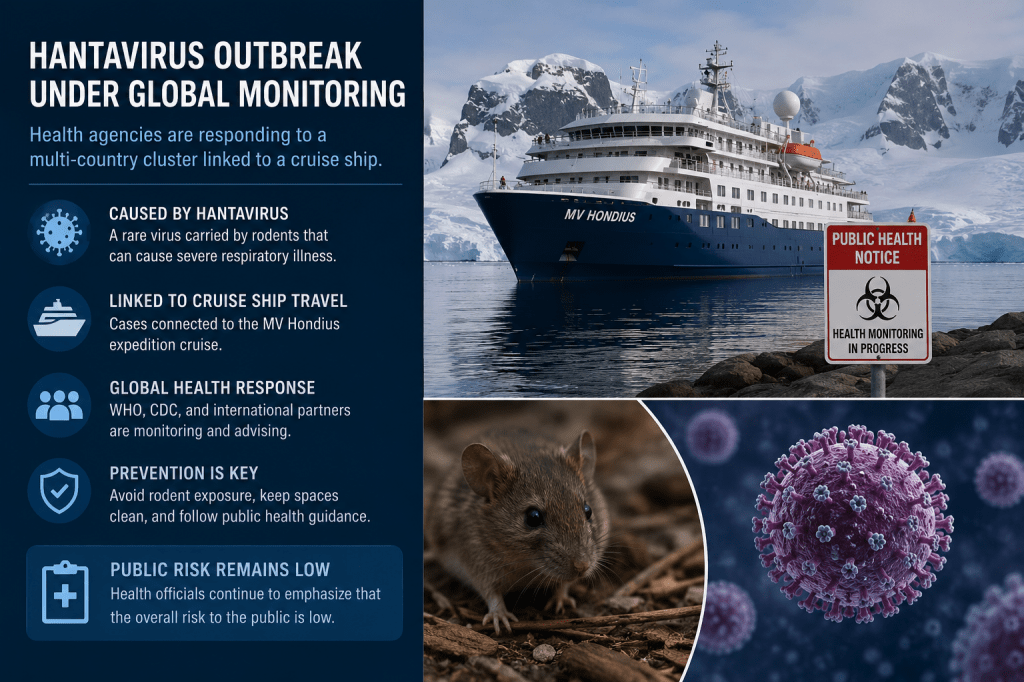
Global health agencies including the World Health Organization (WHO) and the U.S. Centers for Disease Control and Prevention (CDC) are continuing to monitor a multi-country hantavirus cluster associated with cruise ship travel.
The outbreak involves the Andes virus strain of hantavirus, which is primarily found in parts of South America and is notable because limited human-to-human transmission has been documented in previous outbreaks. Health officials continue to emphasize that overall public risk remains low.
Overview of the Current Situation
According to WHO reporting, the outbreak has been linked to passengers aboard the expedition cruise ship MV Hondius. As of mid-May 2026, WHO reported multiple confirmed and probable cases across several countries, including deaths associated with the outbreak.
The CDC has issued public health notices and is monitoring exposed travelers in the United States. Officials have stated that no widespread community transmission has been identified.
Reuters reported that several passengers returning to the United States were placed under quarantine or medical observation, including individuals monitored in Nebraska and Atlanta.
What Is Hantavirus?
Hantaviruses are a group of viruses carried primarily by rodents. Humans usually become infected through exposure to contaminated rodent urine, droppings, or saliva.
In the Americas, hantavirus infections can lead to Hantavirus Pulmonary Syndrome (HPS), a serious respiratory illness that affects the lungs and breathing.
The Andes virus strain involved in the current outbreak is unusual because it is the only hantavirus strain known to demonstrate limited person-to-person transmission under certain conditions involving prolonged close contact.
Symptoms of Hantavirus Infection
Early symptoms often resemble influenza or other viral illnesses and may include:
Fever
Fatigue
Muscle aches
Headaches
Nausea or vomiting
In more severe cases, symptoms may progress to:
Cough
Shortness of breath
Respiratory distress
Fluid buildup in the lungs
WHO and CDC guidance indicates that symptom onset may occur between one and eight weeks after exposure.
How Hantavirus Spreads
Most hantavirus infections occur through environmental exposure to infected rodent waste particles that become airborne.
Health authorities continue to state that hantavirus is not highly contagious in normal public settings. The current outbreak has received attention because of the Andes strain’s rare ability to spread between humans during close and prolonged exposure.
WHO’s current working hypothesis suggests that the initial infection may have occurred before boarding the cruise ship, followed by limited onboard transmission among passengers. Investigations remain ongoing.
Prevention Measures
Public health agencies continue recommending standard hantavirus prevention measures, including:
Avoiding contact with rodents and rodent droppings
Ventilating enclosed spaces before cleaning
Using disinfectants rather than sweeping or vacuuming rodent waste
Sealing gaps and entry points in homes and buildings
Storing food securely to reduce rodent attraction
At this time, there is no routinely approved hantavirus vaccine available in the United States or Europe.
Public Health Response
The outbreak has prompted coordinated monitoring efforts involving WHO, CDC, European health authorities, and national public health agencies.
Some exposed travelers have been advised to undergo monitoring or voluntary quarantine periods of up to 42 days because of the Andes virus incubation window.
Public health experts have also noted that the situation is testing modern outbreak communication strategies developed after the COVID-19 pandemic. Officials have repeatedly emphasized transparency while also discouraging misinformation and unnecessary panic.
Final Takeaway
The hantavirus cluster linked to the MV Hondius cruise ship remains a closely monitored public health event, but health officials continue to emphasize that the overall risk to the public is low.
The situation highlights the importance of disease surveillance, international coordination, and clear public communication when responding to rare infectious disease outbreaks. While the Andes virus strain involved in the outbreak is capable of limited human-to-human transmission, most hantavirus infections worldwide remain associated with rodent exposure rather than widespread community spread.
Medical Disclaimer
This article is intended for informational and educational purposes only and should not be considered medical advice, diagnosis, or treatment.
Readers should consult qualified healthcare professionals regarding medical concerns or symptoms. Scientific understanding and public health guidance may evolve as additional information becomes available.
 Hantavirus Outbreak Watch
Leave a comment