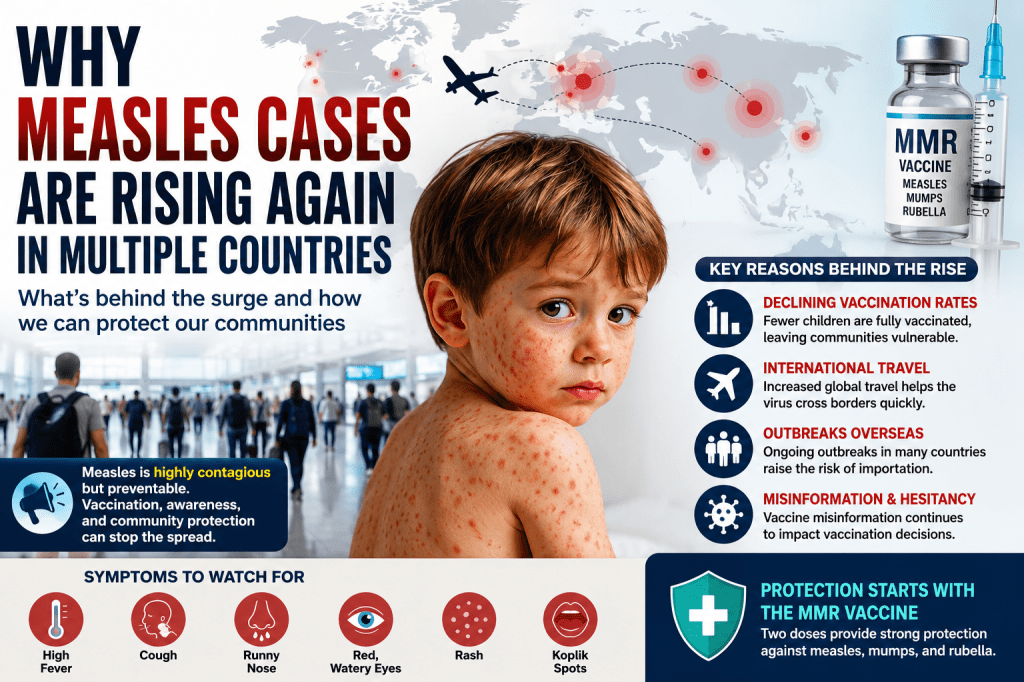
There are some illnesses humanity thought it had quietly pushed into the background — not erased completely, but softened into memory. Measles was one of them.
Yet in 2026, the virus has returned to headlines across multiple countries, airports, classrooms, hospitals, and public health briefings. From North America to parts of Europe and Asia, health officials are tracking a noticeable resurgence in cases, with many outbreaks linked to declining vaccination coverage and international travel.
And while the word “outbreak” can feel heavy, experts continue to emphasize something important: measles is preventable, and public health agencies already know how to slow its spread.
What Is Measles?
Measles is a highly contagious viral illness that spreads through respiratory droplets and airborne particles. The virus can linger in the air for up to two hours after an infected person leaves an area.
Early symptoms often resemble a severe cold or flu before progressing into the classic rash many people associate with measles.
Common symptoms include:
- High fever
- Persistent cough
- Runny nose
- Red or watery eyes
- Fatigue
- Rash spreading across the body
- Tiny white spots inside the mouth (Koplik spots)
According to the CDC and World Health Organization (WHO), measles can also lead to serious complications in some cases, particularly among young children, pregnant individuals, and people with weakened immune systems.
Why Are Global Measles Cases Rising Again?
The current resurgence is not being tied to one single country or event. Instead, health researchers describe it as a combination of several overlapping trends unfolding over recent years.
Declining Vaccination Rates
The biggest factor repeatedly identified by public health agencies is falling routine vaccination coverage.
Measles spreads extremely easily, meaning communities generally need around 95% vaccination coverage to maintain herd immunity and reduce large outbreaks. But in several regions, vaccination rates have slipped below that threshold.
Health experts say the decline stems from multiple causes, including:
- Disruptions to healthcare systems during the COVID-19 pandemic
- Delayed childhood immunizations
- Access barriers in underserved communities
- Growing vaccine hesitancy
- Misinformation circulating online
The result is a widening number of under-vaccinated populations where measles can spread rapidly once introduced.
International Travel Is Accelerating Spread
Modern travel also plays a major role.
Because measles remains active in multiple countries at the same time, infected travelers can unintentionally carry the virus across borders before symptoms fully appear. The CDC Global Measles Outbreaks page notes that outbreaks can emerge in any community with low vaccination coverage once the virus is imported through travel.
Several recent U.S. cases, including clusters investigated in major cities, have been connected to international travel exposure.
Health officials are also paying close attention to large international gatherings and busy summer travel seasons, where crowd density increases opportunities for transmission.
The United States Is Seeing Its Highest Numbers in Decades
The United States declared measles eliminated in 2000, meaning continuous domestic spread had been interrupted.
But recent years have tested that status.
According to updated CDC data, thousands of measles cases have now been reported across dozens of jurisdictions, with the overwhelming majority tied to outbreaks among unvaccinated or under-vaccinated individuals.
Public health researchers at Johns Hopkins Bloomberg School of Public Health say declining vaccination rates over several years helped create the conditions for the current resurgence.
Some analysts have even warned the country risks losing its measles elimination status if transmission continues for prolonged periods.
What Health Agencies Recommend
Public health guidance remains relatively consistent worldwide.
The CDC and WHO continue to recommend the MMR vaccine (measles, mumps, and rubella vaccine) as the most effective protection against measles. Two doses are considered highly effective at preventing infection and severe illness.
Officials also recommend:
- Staying updated on routine immunizations
- Checking vaccine records before international travel
- Monitoring symptoms after exposure
- Seeking medical guidance before visiting clinics if measles is suspected
- Paying close attention to local public health alerts during outbreaks
Importantly, most public health messaging surrounding measles in 2026 has focused on preparedness and prevention rather than panic.
A Reminder of How Connected the World Really Is
Viruses move quietly through the seams of modern life — schools, airports, concerts, neighborhoods, celebrations, vacations.
Measles is reminding the world just how connected global health truly is.
And while the resurgence has raised concern among health experts, many emphasize that the tools to reduce outbreaks already exist. The challenge now is maintaining trust, access, education, and consistent vaccination coverage in an increasingly interconnected world.
Medical Disclaimer
This article is intended for informational and educational purposes only and should not be considered medical advice, diagnosis, or treatment.
Readers should consult licensed healthcare professionals regarding medical concerns or symptoms. Scientific understanding and public health guidance may evolve as new information becomes available.
 Hantavirus Outbreak Watch